

Software Engineering:
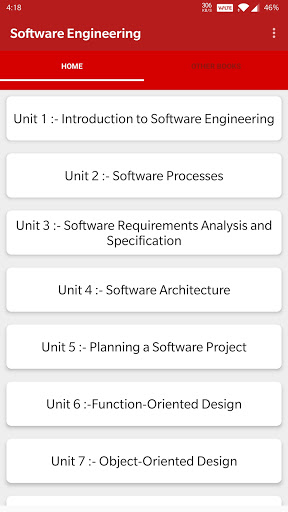
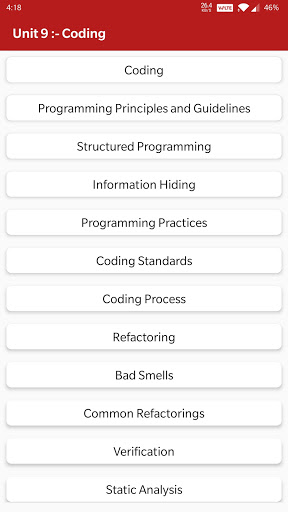
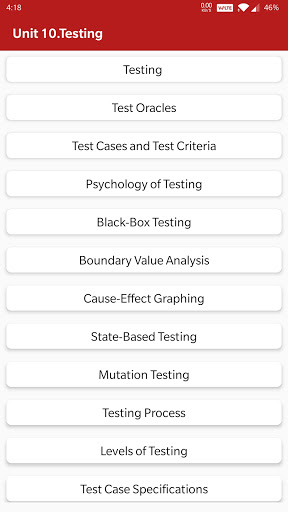
This useful App lists 150 topics with detailed notes, diagrams, equations, formulas & course material, the topics are listed in 10 chapters which contains some important topics like data flow, project management, problem analysis and other programming related coding. The programming app is must have for all the engineering science students & professionals.
The app is a complete free handbook of Software Engineering which covers important topics, notes, materials on the course.
Download the software development app as a reference material & digital book for Computer science engineering programs & software degree courses.
The App is designed for quick learning, revisions, references at the time of exams and interviews.
This app cover most of related topics and Detailed explanation with all the basics topics. Be a professional with this app.
Some of the topics covered in the app are :
1) The Problem Domain
2) Software is Expensive
3) Late and Unreliable
4) Maintenance and Rework
5) The Software Engineering Challenges
6) Scale
7) Quality and Productivity
8) The Software Engineering Approach
9) Phased Development Process
10) Managing the Process
11) Software Development Life Cycle
12) Project Management Methodology
13) S/W Process
14) Component S/W Processes
15) Predictability
16) Support Testability and Maintainability
17) Support Change
18) Early Defect Removal
19) Process Improvement and Feedback
20) Waterfall Model
21) Iterative Development
22) The Spiral model
23) Comparison of Models
24) Project Management Process
25) The Inspection Process
26) Software Configuration Management Process
27) Requirements Change Management Process
28) Process Management Process
29) S/W Requirements Analysis
30) S/W Requirements Specification
31) Requirement Process
32) Problem Analysis
33) Informal Approach
34) Data Flow Modeling
35) Object-Oriented Modeling
36) Prototyping
37) Requirements Specification
38) Characteristics of a Software Requirement Specification
39) Components of a Software Requirements Specification
40) Specification Language
41) Structure of a Requirements Document
42) Functional Specification with Use Cases
43) Examples of use cases
44) Validation
45) Software Architecture
46) Architecture Views
47) Component and Connector View
48) Pipe and Filter
49) Shared-Data Style
50) Client-Server Style
51) Architecture and Design
52) Preserving the Integrity of an Architecture
53) Deployment View and Performance Analysis
54) Documenting Architecture Design
55) Evaluating Architectures
56) The Architectural Tradeoff Analysis Method
57) Project Categorization
58) What is management?
59) Setting objectives
60) The Business Case
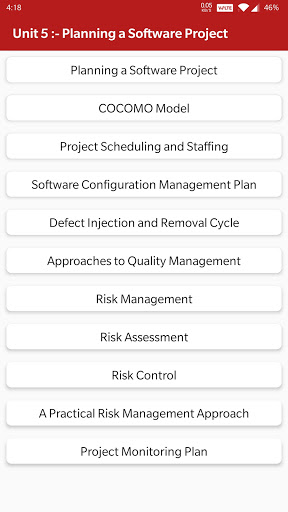
61) Planning a S/W Project
62) COCOMO Model
63) Project Scheduling and Staffing
64) Software Configuration Management Plan
65) Defect Injection and Removal Cycle
66) Approaches to Quality Management
67) Risk Management
68) Risk Assessment
69) Risk Control
70) A Practical Risk Management Approach
71) Project Monitoring Plan
72) Function-Oriented Design
73) Design Principles
74) Problem Partitioning and Hierarchy
75) Abstraction
76) Top-Down and Bottom-Up Strategies
77) Data Flow
Features :
* Chapter wise complete Topics
* Rich UI Layout
* Comfortable Read Mode
* Important Exam Topics
* Very simple User Interface
* Cover Most Of Topics
* One click get related All Book
* Mobile Optimized Content
* Mobile Optimized Images
This app will useful for quick reference. The revision of all concepts can be finished within Several hour using this app.
Instead of giving us a lower rating, please mail us your queries, issues and give us valuable Rating And Suggestion So we can consider it for future updates. We will be happy to solve them for you.
Software engineering is a discipline that involves the systematic development, operation, and maintenance of software systems. It encompasses a wide range of activities, from the initial planning and requirements gathering to the final deployment and maintenance of the software.
The goal of software engineering is to produce high-quality software that meets the needs of its users. This requires a systematic approach to software development that includes the use of well-defined processes, tools, and techniques.
Software Engineering Process
The software engineering process typically consists of the following phases:
1. Planning: This phase involves gathering requirements, defining the scope of the project, and developing a project plan.
2. Analysis: This phase involves analyzing the requirements and developing a design for the software system.
3. Design: This phase involves creating a detailed design for the software system, including the architecture, data structures, and algorithms.
4. Implementation: This phase involves coding the software system according to the design.
5. Testing: This phase involves testing the software system to ensure that it meets the requirements.
6. Deployment: This phase involves deploying the software system into production.
7. Maintenance: This phase involves maintaining the software system after it has been deployed.
Software Engineering Tools and Techniques
A variety of tools and techniques are used in software engineering, including:
* Requirements gathering: This involves gathering requirements from stakeholders and documenting them in a requirements specification.
* Design: This involves creating a design for the software system, including the architecture, data structures, and algorithms.
* Coding: This involves coding the software system according to the design.
* Testing: This involves testing the software system to ensure that it meets the requirements.
* Deployment: This involves deploying the software system into production.
* Maintenance: This involves maintaining the software system after it has been deployed.
Software Engineering Challenges
Software engineering is a challenging discipline that requires a high level of skill and expertise. Some of the challenges faced by software engineers include:
* Complexity: Software systems are often complex and difficult to understand. This can make it difficult to design, implement, and test software systems.
* Uncertainty: The requirements for software systems are often uncertain and can change over time. This can make it difficult to plan and develop software systems.
* Reliability: Software systems must be reliable and able to withstand errors. This can be difficult to achieve, especially for complex systems.
* Security: Software systems must be secure and protected from unauthorized access. This can be a challenge, especially for systems that are connected to the internet.
Software Engineering Trends
The field of software engineering is constantly evolving. Some of the current trends in software engineering include:
* Agile development: This is a software development methodology that emphasizes iterative development and collaboration between developers and stakeholders.
* Cloud computing: This is a model for delivering computing services over the internet. Cloud computing can be used to reduce the cost and complexity of software development.
* Artificial intelligence: This is the field of computer science that deals with the development of intelligent machines. AI can be used to improve the quality and efficiency of software development.
Software Engineering:
This useful App lists 150 topics with detailed notes, diagrams, equations, formulas & course material, the topics are listed in 10 chapters which contains some important topics like data flow, project management, problem analysis and other programming related coding. The programming app is must have for all the engineering science students & professionals.
The app is a complete free handbook of Software Engineering which covers important topics, notes, materials on the course.
Download the software development app as a reference material & digital book for Computer science engineering programs & software degree courses.
The App is designed for quick learning, revisions, references at the time of exams and interviews.
This app cover most of related topics and Detailed explanation with all the basics topics. Be a professional with this app.
Some of the topics covered in the app are :
1) The Problem Domain
2) Software is Expensive
3) Late and Unreliable
4) Maintenance and Rework
5) The Software Engineering Challenges
6) Scale
7) Quality and Productivity
8) The Software Engineering Approach
9) Phased Development Process
10) Managing the Process
11) Software Development Life Cycle
12) Project Management Methodology
13) S/W Process
14) Component S/W Processes
15) Predictability
16) Support Testability and Maintainability
17) Support Change
18) Early Defect Removal
19) Process Improvement and Feedback
20) Waterfall Model
21) Iterative Development
22) The Spiral model
23) Comparison of Models
24) Project Management Process
25) The Inspection Process
26) Software Configuration Management Process
27) Requirements Change Management Process
28) Process Management Process
29) S/W Requirements Analysis
30) S/W Requirements Specification
31) Requirement Process
32) Problem Analysis
33) Informal Approach
34) Data Flow Modeling
35) Object-Oriented Modeling
36) Prototyping
37) Requirements Specification
38) Characteristics of a Software Requirement Specification
39) Components of a Software Requirements Specification
40) Specification Language
41) Structure of a Requirements Document
42) Functional Specification with Use Cases
43) Examples of use cases
44) Validation
45) Software Architecture
46) Architecture Views
47) Component and Connector View
48) Pipe and Filter
49) Shared-Data Style
50) Client-Server Style
51) Architecture and Design
52) Preserving the Integrity of an Architecture
53) Deployment View and Performance Analysis
54) Documenting Architecture Design
55) Evaluating Architectures
56) The Architectural Tradeoff Analysis Method
57) Project Categorization
58) What is management?
59) Setting objectives
60) The Business Case
61) Planning a S/W Project
62) COCOMO Model
63) Project Scheduling and Staffing
64) Software Configuration Management Plan
65) Defect Injection and Removal Cycle
66) Approaches to Quality Management
67) Risk Management
68) Risk Assessment
69) Risk Control
70) A Practical Risk Management Approach
71) Project Monitoring Plan
72) Function-Oriented Design
73) Design Principles
74) Problem Partitioning and Hierarchy
75) Abstraction
76) Top-Down and Bottom-Up Strategies
77) Data Flow
Features :
* Chapter wise complete Topics
* Rich UI Layout
* Comfortable Read Mode
* Important Exam Topics
* Very simple User Interface
* Cover Most Of Topics
* One click get related All Book
* Mobile Optimized Content
* Mobile Optimized Images
This app will useful for quick reference. The revision of all concepts can be finished within Several hour using this app.
Instead of giving us a lower rating, please mail us your queries, issues and give us valuable Rating And Suggestion So we can consider it for future updates. We will be happy to solve them for you.
Software engineering is a discipline that involves the systematic development, operation, and maintenance of software systems. It encompasses a wide range of activities, from the initial planning and requirements gathering to the final deployment and maintenance of the software.
The goal of software engineering is to produce high-quality software that meets the needs of its users. This requires a systematic approach to software development that includes the use of well-defined processes, tools, and techniques.
Software Engineering Process
The software engineering process typically consists of the following phases:
1. Planning: This phase involves gathering requirements, defining the scope of the project, and developing a project plan.
2. Analysis: This phase involves analyzing the requirements and developing a design for the software system.
3. Design: This phase involves creating a detailed design for the software system, including the architecture, data structures, and algorithms.
4. Implementation: This phase involves coding the software system according to the design.
5. Testing: This phase involves testing the software system to ensure that it meets the requirements.
6. Deployment: This phase involves deploying the software system into production.
7. Maintenance: This phase involves maintaining the software system after it has been deployed.
Software Engineering Tools and Techniques
A variety of tools and techniques are used in software engineering, including:
* Requirements gathering: This involves gathering requirements from stakeholders and documenting them in a requirements specification.
* Design: This involves creating a design for the software system, including the architecture, data structures, and algorithms.
* Coding: This involves coding the software system according to the design.
* Testing: This involves testing the software system to ensure that it meets the requirements.
* Deployment: This involves deploying the software system into production.
* Maintenance: This involves maintaining the software system after it has been deployed.
Software Engineering Challenges
Software engineering is a challenging discipline that requires a high level of skill and expertise. Some of the challenges faced by software engineers include:
* Complexity: Software systems are often complex and difficult to understand. This can make it difficult to design, implement, and test software systems.
* Uncertainty: The requirements for software systems are often uncertain and can change over time. This can make it difficult to plan and develop software systems.
* Reliability: Software systems must be reliable and able to withstand errors. This can be difficult to achieve, especially for complex systems.
* Security: Software systems must be secure and protected from unauthorized access. This can be a challenge, especially for systems that are connected to the internet.
Software Engineering Trends
The field of software engineering is constantly evolving. Some of the current trends in software engineering include:
* Agile development: This is a software development methodology that emphasizes iterative development and collaboration between developers and stakeholders.
* Cloud computing: This is a model for delivering computing services over the internet. Cloud computing can be used to reduce the cost and complexity of software development.
* Artificial intelligence: This is the field of computer science that deals with the development of intelligent machines. AI can be used to improve the quality and efficiency of software development.