


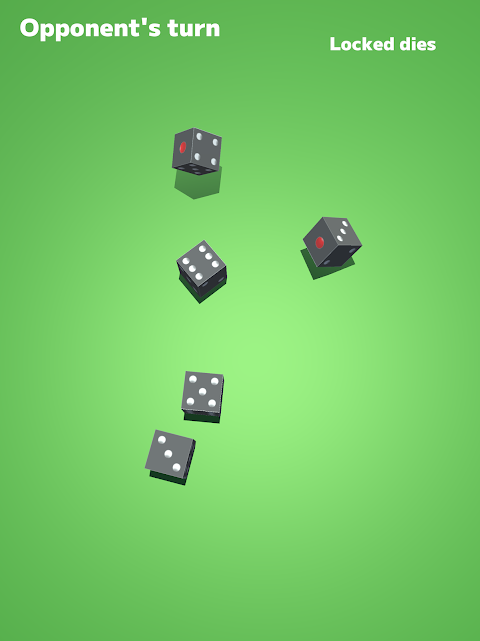

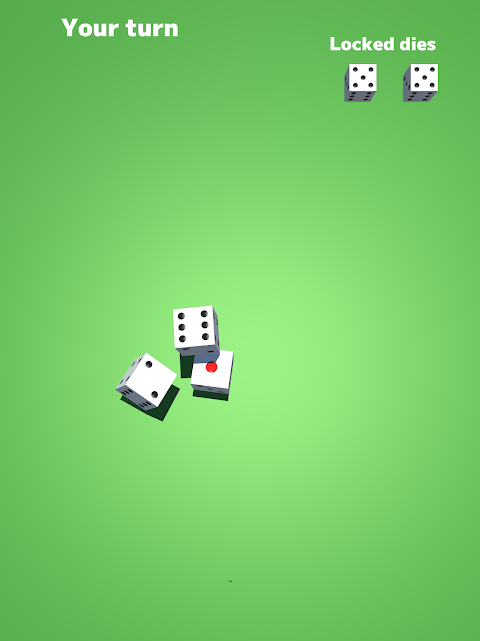
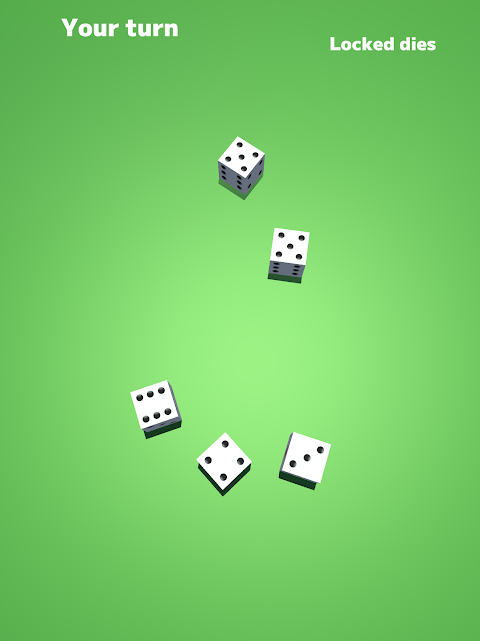
General is a poker-like game with 5 dice.
Called "Generala" in Puer Turkey, it is the most popular and popular dice game.
Sometimes called "Escalero".
There are two players, you and your opponent.
The player rolls the dice on his turn and arranges the hands of the specified combination.
At the end of 10 rounds, the player with the highest score wins.
At the beginning of his turn, the player presses the "roll" button and rolls 5 dice.
After that, he pushes the dice that he does not roll again and locks.
If you press the "roll" button again, the unlocked dice will be rolled again.
You can roll the dice up to 3 times, the first time and the second time.
Roll the dice three times or if you get a good hand in the middle, select a hand from the hand table and press the white square to record the score.
The score of the hand once recorded cannot be erased, so choose the hand carefully.
Also, you cannot pass without recording the score.
Even if you don't have all the hands, you have to choose one of them and record it with 0 point.
When the score is recorded, it will be the next player's turn.
After 10 rounds, the game ends when all the squares on the hand table are filled.
Finally, the player with the highest score wins.
General:
A combination in which all 5 dice are equal.
The score is 60 points. If you confirm the hand the first time, you will get 120 points.
Four of a Kind:
A combination of 4 dice equal.
The score is 40 points. If you confirm the hand the first time, you will get 45 points.
Full House:
A combination with 3 dice equal and a combination with 2 dice equal.
The score is 30 points. If you confirm the hand the first time, you will get 35 points.
Straight:
A combination of 1, 2, 3, 4, 5 and 2, 3, 4, 5, 6 dice. Combinations that connect 6 to 1 such as 3, 4, 5, 6, 1 are also possible. In other words, if the values of 5 dice are all different, it is straight.
The score is 20 points. If you confirm the hand the first time, you will get 25 points.
1 to 6 eyes:
Any combination. The total value of the dice corresponding to the eyes will be the score.
As an example, if the combination of dice is 1, 5, and 5, a score of 1 will be 1 point, and a score of 5 will be 10 points.
General, a classic strategy board game, pits two players against each other in a battle for global domination. The objective is to conquer the world by eliminating all opposing armies. Each player begins with a set number of armies, strategically placed across the game board's territories, which represent continents and countries.
The game unfolds in turns, each comprising three phases: reinforcement, attack, and fortification. The reinforcement phase allows players to bolster their forces. The number of reinforcements received depends on the number of territories controlled, bonus armies awarded for holding entire continents, and the value of any traded-in territory cards. Players collect territory cards by conquering territories during their turn. These cards depict different territories and feature one of three symbols: infantry, cavalry, or artillery. Matching sets of three cards (e.g., three infantry, three cavalry, or one of each) can be traded in for bonus armies. The value of these bonus armies increases with each set traded in.
During the attack phase, players can choose to attack adjacent territories occupied by their opponent. Attacks are resolved using dice. The attacker can roll up to three dice, while the defender can roll up to two. The highest attacking die is compared to the highest defending die, and the lower roll is removed from the board. The second highest dice are then compared in the same manner. If the attacker has more dice than the defender, the attacker's extra die is not used in the comparison. The attacker must leave at least one army in the attacking territory after a successful attack.
The fortification phase allows players to move armies between connected territories they control. This strategic maneuver strengthens defensive positions and prepares for future offensives. Players can move any number of armies during this phase, provided they leave at least one army in the originating territory.
Strategic thinking is crucial in General. Players must carefully consider their deployments, attacks, and fortifications to maximize their chances of victory. Offensive strategies involve concentrating forces to overwhelm enemy positions, while defensive strategies focus on securing key territories and preventing enemy expansion. Controlling entire continents provides significant bonus armies, making them valuable strategic objectives.
Territory cards also play a vital role in the game. Holding matching sets allows players to trade them in for bonus armies, providing a crucial advantage in the battle for global dominance. Players must carefully consider when to trade in their cards, balancing the immediate benefit of additional armies against the potential for even greater rewards later in the game.
Negotiation and diplomacy can also influence the outcome of the game. While General is primarily a game of conquest, players can sometimes form temporary alliances to achieve mutual goals, such as weakening a common enemy. However, these alliances are often fragile and can quickly dissolve as the game progresses and players' interests diverge.
The game continues until one player controls all territories on the board, achieving world domination and victory. The unpredictable nature of dice rolls and the constantly shifting balance of power ensure that every game of General is a unique and engaging experience. Strategic planning, calculated risk-taking, and a touch of luck are all essential ingredients for success in this timeless classic.
The enduring popularity of General stems from its simple yet deep gameplay. The rules are easy to learn, but mastering the strategic nuances requires practice and foresight. The game offers a compelling blend of luck and strategy, providing endless replayability and challenging players of all skill levels. Whether playing with friends or family, General offers a captivating and rewarding experience that has entertained generations of strategists.
The game's accessibility and strategic depth have led to numerous variations and adaptations. Digital versions of General are available on various platforms, allowing players to enjoy the game against computer opponents or other players online. These digital versions often feature enhanced graphics, customizable rules, and even different map scenarios, adding further variety to the classic gameplay.
Despite the evolution of technology and the emergence of countless new games, General remains a beloved classic. Its timeless appeal lies in its ability to provide a challenging and engaging strategic experience that transcends generations. The simple rules, combined with the complex strategic possibilities, ensure that General will continue to captivate players for years to come.
General is a poker-like game with 5 dice.
Called "Generala" in Puer Turkey, it is the most popular and popular dice game.
Sometimes called "Escalero".
There are two players, you and your opponent.
The player rolls the dice on his turn and arranges the hands of the specified combination.
At the end of 10 rounds, the player with the highest score wins.
At the beginning of his turn, the player presses the "roll" button and rolls 5 dice.
After that, he pushes the dice that he does not roll again and locks.
If you press the "roll" button again, the unlocked dice will be rolled again.
You can roll the dice up to 3 times, the first time and the second time.
Roll the dice three times or if you get a good hand in the middle, select a hand from the hand table and press the white square to record the score.
The score of the hand once recorded cannot be erased, so choose the hand carefully.
Also, you cannot pass without recording the score.
Even if you don't have all the hands, you have to choose one of them and record it with 0 point.
When the score is recorded, it will be the next player's turn.
After 10 rounds, the game ends when all the squares on the hand table are filled.
Finally, the player with the highest score wins.
General:
A combination in which all 5 dice are equal.
The score is 60 points. If you confirm the hand the first time, you will get 120 points.
Four of a Kind:
A combination of 4 dice equal.
The score is 40 points. If you confirm the hand the first time, you will get 45 points.
Full House:
A combination with 3 dice equal and a combination with 2 dice equal.
The score is 30 points. If you confirm the hand the first time, you will get 35 points.
Straight:
A combination of 1, 2, 3, 4, 5 and 2, 3, 4, 5, 6 dice. Combinations that connect 6 to 1 such as 3, 4, 5, 6, 1 are also possible. In other words, if the values of 5 dice are all different, it is straight.
The score is 20 points. If you confirm the hand the first time, you will get 25 points.
1 to 6 eyes:
Any combination. The total value of the dice corresponding to the eyes will be the score.
As an example, if the combination of dice is 1, 5, and 5, a score of 1 will be 1 point, and a score of 5 will be 10 points.
General, a classic strategy board game, pits two players against each other in a battle for global domination. The objective is to conquer the world by eliminating all opposing armies. Each player begins with a set number of armies, strategically placed across the game board's territories, which represent continents and countries.
The game unfolds in turns, each comprising three phases: reinforcement, attack, and fortification. The reinforcement phase allows players to bolster their forces. The number of reinforcements received depends on the number of territories controlled, bonus armies awarded for holding entire continents, and the value of any traded-in territory cards. Players collect territory cards by conquering territories during their turn. These cards depict different territories and feature one of three symbols: infantry, cavalry, or artillery. Matching sets of three cards (e.g., three infantry, three cavalry, or one of each) can be traded in for bonus armies. The value of these bonus armies increases with each set traded in.
During the attack phase, players can choose to attack adjacent territories occupied by their opponent. Attacks are resolved using dice. The attacker can roll up to three dice, while the defender can roll up to two. The highest attacking die is compared to the highest defending die, and the lower roll is removed from the board. The second highest dice are then compared in the same manner. If the attacker has more dice than the defender, the attacker's extra die is not used in the comparison. The attacker must leave at least one army in the attacking territory after a successful attack.
The fortification phase allows players to move armies between connected territories they control. This strategic maneuver strengthens defensive positions and prepares for future offensives. Players can move any number of armies during this phase, provided they leave at least one army in the originating territory.
Strategic thinking is crucial in General. Players must carefully consider their deployments, attacks, and fortifications to maximize their chances of victory. Offensive strategies involve concentrating forces to overwhelm enemy positions, while defensive strategies focus on securing key territories and preventing enemy expansion. Controlling entire continents provides significant bonus armies, making them valuable strategic objectives.
Territory cards also play a vital role in the game. Holding matching sets allows players to trade them in for bonus armies, providing a crucial advantage in the battle for global dominance. Players must carefully consider when to trade in their cards, balancing the immediate benefit of additional armies against the potential for even greater rewards later in the game.
Negotiation and diplomacy can also influence the outcome of the game. While General is primarily a game of conquest, players can sometimes form temporary alliances to achieve mutual goals, such as weakening a common enemy. However, these alliances are often fragile and can quickly dissolve as the game progresses and players' interests diverge.
The game continues until one player controls all territories on the board, achieving world domination and victory. The unpredictable nature of dice rolls and the constantly shifting balance of power ensure that every game of General is a unique and engaging experience. Strategic planning, calculated risk-taking, and a touch of luck are all essential ingredients for success in this timeless classic.
The enduring popularity of General stems from its simple yet deep gameplay. The rules are easy to learn, but mastering the strategic nuances requires practice and foresight. The game offers a compelling blend of luck and strategy, providing endless replayability and challenging players of all skill levels. Whether playing with friends or family, General offers a captivating and rewarding experience that has entertained generations of strategists.
The game's accessibility and strategic depth have led to numerous variations and adaptations. Digital versions of General are available on various platforms, allowing players to enjoy the game against computer opponents or other players online. These digital versions often feature enhanced graphics, customizable rules, and even different map scenarios, adding further variety to the classic gameplay.
Despite the evolution of technology and the emergence of countless new games, General remains a beloved classic. Its timeless appeal lies in its ability to provide a challenging and engaging strategic experience that transcends generations. The simple rules, combined with the complex strategic possibilities, ensure that General will continue to captivate players for years to come.